Thursday, December 22, 2011

Rejoicing in False Blame


When the time of the annual meeting was drawing near, Francis said to his fellow, “It seems to me that I am not a Friar Minor, unless I am in the state which I will tell you. Look how the friars invite me with honor to the Chapter and moved by their devotion I go to the annual meeting with them.  But once gathered together, they ask me to announce to them the Word of God and to preach among them.  And rising up, I preach to them as the Holy Spirit had taught me.  If it should be, after I have finished my sermon, they all cry out against me, ‘We will not have you to rule over us for you are not eloquent, as is right, and you are too simple and idiotic and we wouldn’t want such a simple and despised a superior over us.  Therefore, do not call yourself our leader!’  In this way they cast me out with blame and reproach.  It would seem to me then that I was not a Friar Minor, if I did not rejoice to the same extent when they reproached me and cast me out with shame, unwilling that I should be their leader, as when they venerate and honor me—holding their benefit and usefulness to be equal in either case.  For if I am glad when they exalt and honor me on account of their devotion, where there may still be a danger to my soul—then much more should I rejoice and be glad of my personal benefit and the salvation of my soul when they blame me, because the gain to my soul is certain.”
                        -Mirror of Perfection, Section IV, Chapter 64

This may seem another example of Francis' extremism.  But Francis is simply putting together two principles of Jesus.  

Jesus said that we are not to take honor in outward show.  He commanded this in Matthew 6, where our prayers are to be secret and our fasting private only to God.  Jesus also said in Matthew 23 that leaders who make a display in order to receive honor should only have shame.  Any leader who is recognized for great works or how wonderful they are should be made uncomfortable by adulation. 

Jesus also said that his true disciple would have persecution and rejection.  Paul went so far as to say, "Anyone who lives a godly life in Christ Jesus will be persecuted."  Thus, when persecution comes, we ought to rejoice that we are true disciples of Jesus, and not reject it at all.  Even so, in Acts 5, when the apostles were scourged, they rejoiced that they were counted worthy to suffer for Jesus' name.  

How often do we have that attitude when being rejected for doing right?  Perhaps we should meditate like Francis more often, to be ready to accept persecution correctly when it comes.

Hypocrisy


As Francis went through the city of Assisi, a certain poor old woman begged an alms of him for the love of God.  And he immediately gave her the mantle which he had on his back and without delay he confessed in the presence of those who followed how in this he had pride.  And we have seen and heard so many other example like this of his great humility, we who were always in his company, that neither with words nor with letters can we narrate them.  For Francis had his main focus on that he would not be a hypocrite before God, and though on account of his infirmity a liberty would be necessary to him, yet he took thought with himself, always to show a good example to the friars and to others, so that he sustained all poverty patiently that he might take away from everyone all occasion of murmuring.
                        -Mirror of Perfection, Section IV, Chapter 63

As in the last selection, we see Francis' high demands on himself requires shame that we might not recommend to others.  Perhaps it is enough that Francis could have a private confession of his thoughts of pride.

On the other hand, like Jesus, Francis took hypocrisy very seriously.  If it looked like he was doing one thing, but really doing another, he wanted it to be known, and to recognize that his thoughts aren't always saintly.  Francis may or may not have sought to be a saint, but he knew himself to often not have holy or loving intentions.  This is important for all of us.  We need to clearly see ourselves as who we really are, and not make ourselves to be more holy, more religious, more pious or more God-loving than we really are.

There are many churches that encourage the opposite.  They want to see more God language, more praising, more outward show.  This isn't necessarily bad, but if there isn't also the outward confession of saying what one doesn't really feel or acting in a way that doesn't reflect a real inner life, that is bad.

We've got to recognize all of our occasional hypocrisy.  But we also need to do what we can to do away with such religious falsity. 

Tuesday, December 13, 2011

Scruples


At one point, Francis had suffered from an illness, but he had become a little stronger after the worst of it.  It seemed to him that he had given himself some leniency during that weakness, even though he had only eaten a little.  He arose one day, although he was not yet free from the fever, and he had the people of Assisi called together in the marketplace, for preaching.  When his sermon was done he warned the people that no one should go away from there until he returned to them.  Then he entered the cathedral of St. Rufinus with many friars and with Brother Peter of Catana who had been canon of that church and was chosen first Minister-General by Francis, he spoke to that brother peter, ordering him by obedience, that he should without contradiction do whatever he said to him.  Brother Peter answered, “Brother, I neither may nor ought, will or do anything except as it may please you.”  Casting off his tunic, Francis told him to bind a cord around his neck and to drag him naked to the place where he had preached, and then at that place to throw ashes over his face.  But Brother Peter did not obey him because of the compassion he had for him.  But Peter did take the cord bound around his neck, dragged him out, as Francis had ordered.  He was weeping so hard, and the other friars who were with him shed tears of compassion and of bitterness. 

            When Francis had been led naked before everyone up to the place where he had preached, he said, “You, and all those who, after my example, leave this world and enter religion and the life of the friars, believe me to be a holy man, but I confess to God and to you that I have eaten in my infirmity meat and broth made from meat.”  And all began to weep over him for great pity and compassion, especially because it was then Winter and a very intense frost, and he was not yet recovered from his fever.  Striking their breasts, they accused themselves, saying, “If this saint, for just and clear necessity, accuses himself with so much shame—although we know him to be holy, and we know to be living in the flesh as if almost dead on account of the great abstinence and austerity which he has made to his body from the beginning of his conversion to Christ— what shall we wretched ones do, who for the whole time of our lives have lived and still live according to the desires of our flesh?”
                        -Mirror of Perfection, Section IV, Chapter 61

Was Francis justified to condemn himself for such a small action?  We don't know his heart, or his personal commitment before God, but certainly eating some extra protein when he is sick isn't a sin.  In fact, if it were one of Francis' brothers, he would insist that the brother be forgiven and that nothing be done in punishment to him.  But Francis wouldn't forgive himself.  His guilt was such that he insisted on such an extreme punishment.

God does not require such dramatics in order to be forgiven.  God wants a penitent heart and a confessing mouth, and God is ready to forgive.  Francis himself displays that in other stories.  For some of us, it is much harder for us to forgive ourselves than it is for God to forgive us, or for us to forgive others.  We need to remember that God demands mercy, not sacrifice-- even for ourselves.  If God has forgiven us and we refuse to forgive ourselves, then we are calling God a liar.

Wednesday, November 30, 2011

Accepting the Outcast


Francis, having returned to the church of blessed Mary of the Porziuncula, found Brother James the Simple with a certain leper much ulcerated.  For Francis has commended that leper and all others to him, because he was as it were their physician, and he freely touched their wounds and cleansed them and took care of them, for then the friars used to abide in the hospitals of the lepers.

            But Francis said to Brother James, as if reproving him, “You ought not to lead out these Christians, because it is neither decent for you nor for them.”  For though he wished to serve them, he did not wish that those who were most afflicted to be taken out of the hospital because people would be abhorred in seeing them.  Brother James was so simple that he used to go with them from the hospital to the church of St. Mary of the Porziuncula, as he would have gone with one of the friars.  And Francis used to call the lepers Christian brothers. 

            After Francis had said this, he immediately blamed himself, believing that the leper had been put to shame for the blame which he had thrown on Brother James.  Therefore, desiring to satisfy God and the leper, he confessed to Brother Peter of Catana, who was then Minister-General.  And he said, “I wish that you would confirm to me the penance which I have chosen to do for this fault and that you would not contradict me.”  He answered, “Brother, do as you please,” for Brother Peter so venerated and feared him that he did not presume to contradict him, even though Francis was often afflicted with guilt.  Then Francis said, “Let this be my penance, that I eat of the same dish as my Christian brother.” 

Therefore, when Francis sat down to the table with the leper and with other friars, one dish was placed between Francis and the leper.  But the leper was all ulcerated and loathsome, and especially he had his fingers shriveled and bleeding with which he took up lumps from the dish, so that when he put them in the dish the blood and matter of the fingers flowed into it.  And, seeing this, Brother Peter and the other friars were saddened, but did not dare to say anything on account of the far and reverence of Francis.  He who saw this wrote it down and bears testimony of these things.
                        Mirror of Perfection, Section IV, Chapter 58

Francis, Francis.  What am I going to do with you?  

Francis' impulse was wonderful here.  He wanted to feed and clean the lepers, and this was partly because of his own deep fear of lepers from a young age.  Of course, we now know that leprosy (now called Hansen's Disease) isn't really contagious to adults.  But in the ancient world, it was considered extremely contagious. 

Francis was so mortified by his possible rejection of unity with his leper brother that he caused even MORE embarrassment to the leper by insisting that they ate of the same bowl, and then calling it "penance". 

Francis wanted to accept the outcast, especially the outcast he was particularly averse to.  It is a good notion, but what is more important that we love all the outcast, which means radical acceptance, even in the fact of society's rejection.  The mentally ill, the homeless, homosexuals, felons, and all others that are rejected by society, we need to go out of our way to accept.  Not in a halfhearted way, like Francis, but with full love, and full joy.  This doesn't mean we don't take care to not recognize the weaknesses of those we accept-- whether it be contagion or potential criminal behavior.  But we find ways to make our friends be comfortable and helped in as much as we can.


Wednesday, November 16, 2011

Cleanliness Next to Godliness


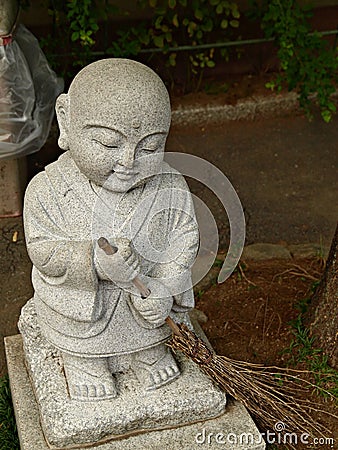
On a time when he was staying at St. Mary of the Porziuncula, and there were as yet but few friars, blessed Francis went by those villages and churches in the neighborhood of Assisi announcing and preaching to men that they should do penance, and he carried a broom to sweep out unclean churches.  For the holy Father grieved much when he saw any church not so clean as he wished.  And therefore, when the preaching as finished, he always made all the priests who were there gather together in some remote place, lest he should be overheard by the lay folk, and preached to them of the salvation of souls and especially that they should be careful to keep clean the churches and altars, and all things which pertained to the celebration of the divine mysteries.
                        -Mirror of Perfection, Section IV, Chapter 56

Early in Francis' life he was called by God to "Rebuild my Temple." Francis at first thought he was to repair a chapel near his town.  So it only makes sense that he would become a fanatic about churches being clean.  It's kind of how he started on the path to sainthood.

Cleanliness by itself isn't that significant.  It's nice to keep things clean, but not at the heart of godliness.  However, to clean for another is to show respect for them.  It is to humble oneself low enough to do a demeaning task that we pay minimum wage for.  Cleaning for others, and especially cleaning for God, is important for a healthy soul. 


Wednesday, November 9, 2011

Francis Animated

A cartoon giving a non-canonical story about Francis and Brother Philip.  I like the animation.  Kinda VeggieTalesish. 

Rejoicing in the Poor Offering


Francis, seeing that the Lord wished to multiply the number of his friars, said to them, “Dearest brothers and my little sons, I see that the Lord wills to multiply us.  So it seems good and religious to me that we should obtain either from the canons of St. Rufinus or from the Abbot of St. Benedict, some church where the friars may say their Hours and only have near it some small sorry hut constructed from mud and branches, where the brethren may rest and work.  For this place is not fitting nor sufficient to the friars, since the Lord wishes to multiply them and especially since we have here no church where the friars may say their Hours.  And if any friar should die, it would not be fitting to bury him here, nor in a church of the secular clergy.”   And this speech pleased all of the friars.

            So he went to the Bishop of Assisi, and laid the request before him.  The Bishop replied to him, “Brother, I have no church which I can give you,” and the canons also said the same.  Then he went to the Abbot of St. Benedict of Monte Subasio and laid the same proposition before him.  But he Abbot, moved with piety, having counseled with his monks, with the divine will and grace operating, conceded to Francis and his friars the church of St. Mary of the Porziuncula, as the smallest and poorest church they had.  And the Abbot said to blessed Francis, “Behold, brother, we have granted what you have asked.  But if the Lord should multiply this congregation, we wish that this place would be foremost among your dwellings.” 

And the speech pleased Francis and his brothers, and Francis rejoiced greatly concerning the place conceded to the friars, especially on account of the name of the church, of the Mother of Christ, and because it was so small and poor a church, and also because it was named the Porziuncula, in which it was prefigured that it should be the head and the mother of the poor Friars Minor.  For the church was called the Porziuncula, because of that court which was formerly called “the little portion.”  So Francis was given to say, “The Lord wished that no other church should be granted to the friars, and that the first friars should not as then build a new church nor have any other except that, since by this, through the advent of the Friars Minor, a certain prophecy was fulfilled.”  

And though it was poor and now destroyed, yet for a great time the men of the city of Assisi and of all its lordship had had great devotion to that church, and they have a greater today and dail honor it.  So as the brothers went there to live, from that time the Lord multiplied their number almost daily and their reputation was wonderfully scattered through all the valley of Spoleto, and many parts of the land.  Yet of old it was called St. Mary of the Angels because, as it was said, the songs of Angels and of celestial spirits were there heard of those coming to the place.
                        -Mirror of Perfection Section IV, Chapter 55


I love this story partly because it reflects an event that happened in the early days of Anawim. 

In 2003, my family and I were being kicked out of our apartment because we invited the homeless to visit and sometimes stay with us.  The new owner didn't like our kind of people, so he gave us a 30 day notice, which was his right.  However, years before we had moved in without a deposit in the lowest rent district in town... and finding a new place would be difficult at best.  Frankly, we just didn't have the money for it. 

I called two people for prayer-- my pastoral overseer and my father-- for prayer, because we didn't know what to do.  Two days later, my father called me and offered to purchase a house for us.  

We were shocked, and praising God, and overjoyed.  But we also realized that we had only a little time to find another place.  So we looked at the internet, and we sought God.  I felt God was saying to look nearby downtown Portland, so we did... with no luck.  It wasn't so much that the places around downtown were so expensive, but that they were so difficult to do ministry out of.  We had a family of five who were ministering to the homeless-- what kind of house would do for that?

Diane (my wife) and I took to driving down streets, looking for houses for sale.  One house we drove by was just right-- it was large, and just north of downtown Portland. Diane said, "It's going to be way too expensive."  I said that it couldn't hurt to try, so we called our realtor and set up an appointment.  

The house WAS huge.  It had six bedrooms and a couple sheds in the back.  It had a shower downstairs that could be used for the homeless.  And it wasn't too expensive.  The sellers were an old couple who had done ministry to the homeless out of the house for years.  We took a liking to each other just as soon as we met.  It was done.

However, the house was beat up, torn down, and filled with at least thirty years of junk.  There were whole rooms full of trash and old wood.  It took almost a year to clear it all out.  The wiring was old and problematic.  But overall, it is wonderful and we appreciate it so much.

We have had dozens of people stay in our house-- at one point we had as many as 16 people in the house.  It is a wonderful gift of God-- and my father-- and we appreciate it every day.   

A gift that is broken down and weak is still a gift.  And the gift given with generosity and sincerity will always be rewarded.

Wednesday, October 26, 2011

Truth Through Presence


While he was staying at Siena, there came to him a certain doctor of divinity of the Order of Preachers, a man both humble and spiritually righteous.  After discussing with Francis for some time concerning the words of the Lord, the doctor asked him concerning the words of Ezekiel, “If you do not speak to warn the wicked from his wicked ways, his blood will I require at your hand.”  The doctor said, “I know many, however, good Father, that are in mortal sin, to whom I do not speak to warn them of their impiety—will their souls then be required at my hands?”  

Francis humbly replied that he was but a simpleton, and that therefore he would rather be taught of him rather than explaining to this doctor the meaning of Scripture.  The humble master replied, “Brother, though I have heard an exposition of this text from many wise men, yet I would willingly learn your understanding of it.”  Therefore Francis said, “If the text is to be understood for all, I would take it this way—that the servant of God should so burn and shine forth by life and holiness in himself, that by the light of his example and by the speech of his holy conversation he should reprove all the impious.  Thus, say I, the glory and the odor of his reputation will announce to all their iniquities.”  The doctor then left being edified and said to his brothers, “My brothers, the theology of this man, founded on purity and contemplation, is a flying eagle, while our study crawls on its belly on the earth.”
                        -Mirror of Perfection Section IV, Chapter 53

It is said that Francis spoke, “Speak the gospel at all times.  If necessary use words.”

Words are necessary, and they can at times be a clear presentation of the gospel.  But we must remember that the gospel of Jesus is not only His teachings, but His life.  Not only did Jesus teach us God’s truth, he showed it to us.  In this way, we should have learned, that the True Teacher not only speaks, but lives out her teaching.

Even if we never say a word, let the light of God’s presence be shown through our actions.  May the love of the Holy Spirit display God’s love before we ever open our mouth about His grace.

Responding to Criticism


This we have seen with our eyes who were with him as also he himself witnessed, that when some of the friars did not satisfy him in his requirements, or said to him some word with which a man would be disturbed, he immediately went to prayer and when he returned, he would remember nothing.  He would never say, “This one disturbed me,” or, “This one said this to me.”  In this way he persevered and so much more as he drew near to death, considering how he might live and die in all humility and poverty and in perfection of all the virtues.
                        -Mirror of Perfection Section IV, Chapter 46


Ah, I wish I could be as Francis in this area.  I, as well as many of us, brood over the negative input we receive, the criticisms and barbs that people throw at us.  Sometimes they keep us up at night, squeezing our sleep from us, wondering what we could say in response, wishing we had been wise enough to say a good thing, or quick enough to respond in kind. 

The true wisdom of Francis is evident, for he takes such matters to prayer.  Then, offering such negativity to the Lord, he then forgets about it.  For how can one, being in the glory of the Ever Loving One, remember such insignificant matters as destructive language that passes away like a leaf in autumn?  Only love remains forever.  Let us leave all bitterness and anger behind for what endures.

Wednesday, October 19, 2011

Surrendering Leadership


Francis wished to remain in perfect humility and subjection to his death.  So, some time before his death, he said to the Minister-General, “I wish that you would place your rule over me to one of my brothers, to whom I may do obedience in your place.  In this way I might obtain the merit of obedience that I desire in life and it would remain for me in death.” So from that time forward he had one of his brothers as a warden, whom he obeyed instead of the Minister-General. 

            At one time he said to his brothers, “The Lord has granted me this grace amidst all the others—to obey as diligently the novice who enters the Order today, if he were assigned to me for a Warden, as he who is foremost and ancient in life and in the Order.  For a subject should not look upon his superior as a man, but as God for whose love he is subject to him.”  Later he said, “There is no prelate in the whole world who is to much feared as the Lord would make me to be feared, if I so wished it, by my brethren.  But the Lord has granted me this grace, that I wish to be content with all, as he that is lease in the Order.”
                        -Mirror of Perfection Section IV, Chapter 46

Of all things that Francis did, I find this to be the most amazing.  Francis surrendered his leadership of the order he founded, and the vision he developed, to another and chose to put himself under the orders of another. 

It is natural for people to want to retain what they have received.  If they have gained a regular benefit—even at the generous hand of another—they will be angry if that benefit is taken away, for it feels like an injustice to them.  If we have obtained a certain amount of power, we want to keep that power long after the retaining of it has helped others.  Francis’ humility was such that not only did he surrender leadership, but he moved his position from one of authority to one of complete subservience.  Unbelieveable.
                                                                                                                                                            
And yet, this is the kind of leadership Jesus’ requires.  “The elder shall serve the younger.”  Jesus commands His leaders to undertake whatever sacrifice necessary to act for the benefit of all.  Sometimes this will mean making commands.  Sometimes this will mean receiving commands from those underneath.  Only God can grant us the grace to do either, and to give us the wisdom to know when one should be done or the other.